(1).png)


1. The 2026 Shift: From Passive Storage to Active Intelligence
For two decades, LegalTech was about "Digitization"—moving paper to the cloud. In 2026, the focus has shifted to Extraction and Linkage.
| Feature | The Documentation Era (2010–2024) | The Auto-Discovery Era (2026+) |
| User Role | Searcher: Keywords and folder browsing. | Strategist: Reviewing agent-found patterns. |
| Logic Layer | OCR (Optical Character Recognition). | Semantic Reasoning: Understanding intent and context. |
| Speed | Weeks of "Manual Review." | Real-Time: Continuous crawling of data streams. |
| Outcome | A list of relevant documents. | A "Fact Map" and Risk Narrative. |
2. 3 Pillars of the Auto-Discovery Stack
A. Autonomous Continuous Crawling
Modern LegalTech doesn't wait for a "Discovery Request." It acts as an Always-On Auditor.
The Workflow: AI agents continuously monitor a corporation’s Slack, Email, and Project Management tools.
They flag "Contractual Drift" (where actions deviate from signed agreements) before a breach even occurs.
B. Generative Fact-Mapping
In 2026, discovery is about Chronology and Causality.
The Tech: Using Graph Databases and RAG (Retrieval-Augmented Generation), the software automatically builds a visual timeline of an event. It links a specific email in January to a financial transaction in June, identifying the "Smoking Gun" without a human having to read 10,000 PDFs.
C. Cross-Jurisdictional Logic
As global laws become more fragmented, Auto-Discovery tools handle the "Compliance Translation" layer.
The Logic: If a new privacy law is passed in California, the agent automatically "discovers" every contract in your repository that is now non-compliant and drafts the necessary amendments.
3. Why "Search" is Dying in LegalTech
According to 2026 benchmarks, the traditional search bar is a bottleneck. Lawyers no longer want to "Search for the contract with Company X." They want to "Discover the liability risk with Company X."
Intent-Based Discovery: Instead of keywords, lawyers use Natural Language Objectives. "Find every instance where we promised 99.9% uptime but failed to deliver in the Punjab region."
Predictive Precedent: The system discovers past rulings that are semantically similar to the current case, even if the "keywords" don't match, providing a strategic advantage in litigation.
4. 2026 SEO & GEO Strategy: Ranking for "Legal Certainty"
As law firms move toward Autonomous Discovery, they are searching for Efficiency Benchmarks.
Target "Outcome" Keywords: Focus on "Reducing discovery time by 90%," "AI-driven contract risk mapping," and "Automated EU AI Act compliance."
GEO (Generative Engine Optimization): Use Schema.org/LegalService and FactCheck data. AI search models (Gemini 3, Perplexity) prioritize platforms that offer verifiable "Time-to-Fact" metrics.
Authority Signals: Publish "Benchmarking Reports" comparing manual human discovery vs. Auto-Discovery. In 2026, Transparency is the New Marketing.
5. Privacy-by-Design: The 2026 Compliance Moat
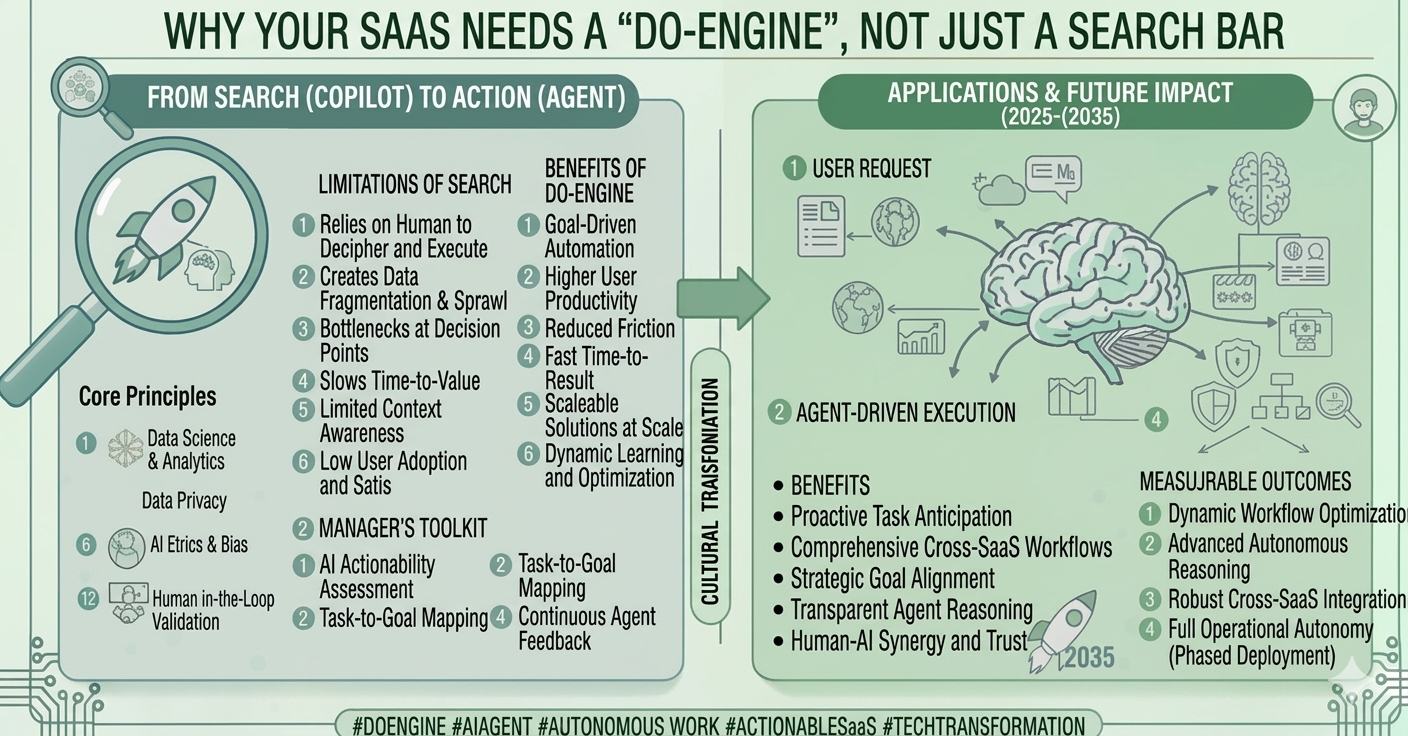
For a "Do-Engine" to work in law, it must be Privacy-Native.
Local Inference: To protect attorney-client privilege, 2026's top LegalTech runs Small Language Models (SLMs) locally on the firm's private cloud, ensuring no sensitive discovery data ever trains a public model.
Immutable Logs: Every "Discovery Action" is logged on a tamper-evident ledger, satisfying the stringent EU AI Act transparency requirements for high-risk legal AI.
Summary: From Archivists to Architects
The "Discovery" phase used to be the most expensive and tedious part of legal work. In 2026, it is a background process. By moving from static documentation to Auto-Discovery, LegalTech SaaS allows attorneys to stop being "Digital Archivists" and start being the "Strategic Architects" their clients need.