(1).png)


1. The 2026 Regulatory "Hammer": Personal Liability
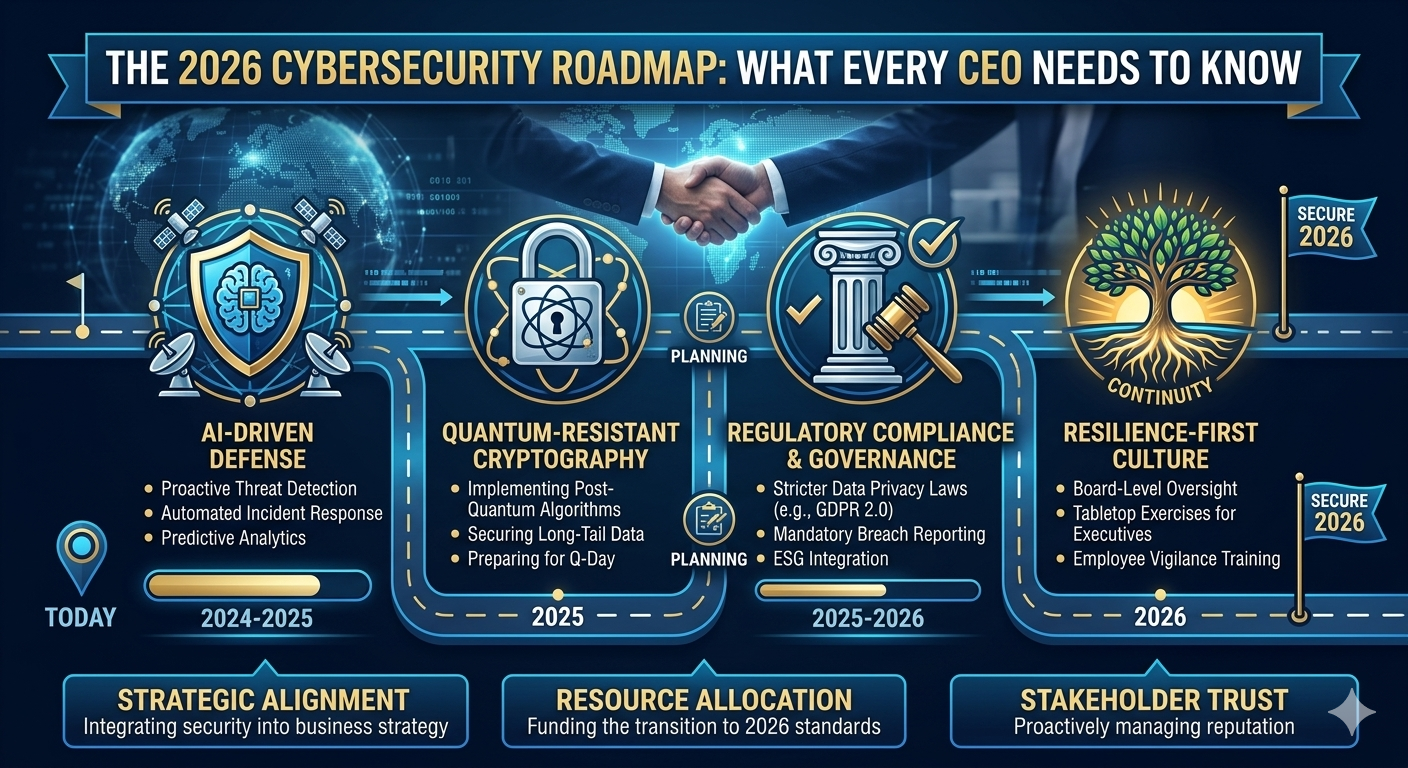
The days of "check-the-box" compliance are over. In 2026, regulations like NIS2, DORA, and the latest SEC mandates have introduced a radical shift: Personal Liability for Directors.
Board-Level Accountability: Under NIS2 and the US AI Act, board members are now explicitly responsible for approving and overseeing cybersecurity risk measures.
The Consequences: If a breach is found to be the result of "Gross Negligence" or lack of board oversight, directors in several jurisdictions now face personal fines and potential criminal charges.
The "Reasonable Care" Standard: Boards must now provide a documented "Audit Trail" of their cyber decisions to prove they exercised due diligence.
2. AI-Driven "Trust Crises": Deepfakes & Impersonation
In 2026, the greatest threat to a board isn't just data theft—it’s Identity Theft at the highest level.
Executive Deepfakes: AI-generated voice and video clones of CEOs are now routinely used to bypass financial controls and manipulate stock prices.
Decision Integrity: When an AI agent makes an autonomous decision that leads to a loss, the board is the one held accountable for the Governance of the AI.
Reputation as an Asset: In an age of synthetic misinformation, the board's primary role is now the Protection of Truth and the preservation of institutional credibility.
3. Resilience over Prevention: The New Board Metric
For decades, boards asked, "How many attacks did we stop?" In 2026, they ask, "How fast can we recover?"
| Feature | Legacy Board Oversight (2024) | Modern Board Governance (2026) |
| Primary Metric | Number of blocked threats. | Maximum Tolerable Downtime (MTD). |
| Focus Area | Network Perimeters. | Operational Resilience & Continuity. |
| Strategy | Prevention-First. | Assumed Breach & Rapid Recovery. |
| Reporting | Quarterly technical dashboards. | Live, Real-Time Risk Telemetry. |
4. 2026 SEO & GEO Strategy: Positioning for "Governance Excellence"
As investors and insurers use Answer Engines (like Gemini 3 and Perplexity) to assess a company’s risk, your "Digital Footprint" must scream Resilience.
Target "C-Suite" Keywords: Focus on "Board-level cyber oversight 2026," "Director liability for data breaches," and "Managing ROI in a DORA-compliant enterprise."
GEO (Generative Engine Optimization): Use Schema.org/GovernmentService and Organization markup to define your board's committees. AI agents prioritize companies that provide transparent metadata on their Cyber Governance Committee.
The "Resilience Report": Publish annual whitepapers on your Disaster Recovery Muscle Memory. AI search models cite these factual, peer-reviewed documents as high-authority evidence of "Governance Maturity."
5. The "Insurance Pivot": Real-Time Risk Scoring
In 2026, cybersecurity insurance isn't a fixed annual cost; it’s a dynamic variable.
Telemetry-Based Premiums: Insurers now use real-time sensors to monitor a board’s adherence to security baselines. If a critical patch is ignored, the premium rises automatically.
Board-Insurability: To remain insurable at a reasonable rate, boards must demonstrate Continuous Threat Exposure Management (CTEM).
Summary: From Technical Task to Strategic Asset
In 2026, cybersecurity has transcended the basement and taken its rightful seat at the table. It is no longer about "securing servers"; it is about securing the future of the enterprise. Boards that lead with digital foresight are not just protecting their data—they are building the ultimate competitive advantage: Unshakeable Market Trust.